Local SEO services for small businesses: 6 things we do to get you more calls
Local SEO services help a business appear in Google Maps and local search results when nearby customers look for what it offers. The work covers six areas: your Google Business Profile, local pages on your website, citations across directories, reviews from real customers, regular profile updates, and tracking of calls and enquiries. Our plans start at $350 a month per location.
Each task tied to what actually drives local rankings.
Google-compliant only: real name, real address, real reviews.
Written updates every two weeks, in plain English.
I’ve done Google Maps and local SEO work for 6 years. The work that moves results is usually unglamorous: the right primary category, services written the way customers search, consistent details everywhere and a steady flow of real reviews.
I’m Đăng from SME Solution. Most local SEO service pages list the same tasks without explaining why they matter. This page ties every task to the evidence behind it: Google’s own description of how local ranking works, and the 2026 survey in which 47 local SEO experts scored 187 ranking factors. If you know why each task matters, you can judge any provider’s work, ours included.
What local SEO services include
A complete local SEO service covers six areas. Profile-only plans cover the first, fifth and sixth; full plans cover all six.
Google Business Profile optimization: categories, services, products, hours, description and photos.
Local landing pages: pages on your website for your main services and the areas you serve.
Citations and listing cleanup: consistent name, address and phone number across directories.
Reviews: a routine for asking real customers, and replies to every review.
Posts, photos and Q&A: regular updates that keep the profile active and useful.
Tracking and reporting: calls, direction requests, website clicks and local rankings.
How Google ranks local businesses
Before deciding what to work on, it helps to know what Google is looking at. Google’s help documentation says local results are based mainly on three things.
Relevance: how well a profile matches what someone searched for.
Distance: how far the business is from the person searching, or from the location in the search.
Prominence: how well known the business is, including, in Google’s words, how many websites link to it and how many reviews it has.
Google also says there is no way to request or pay for a better local ranking. That single sentence rules out every “guaranteed top 3” offer you’ll come across.
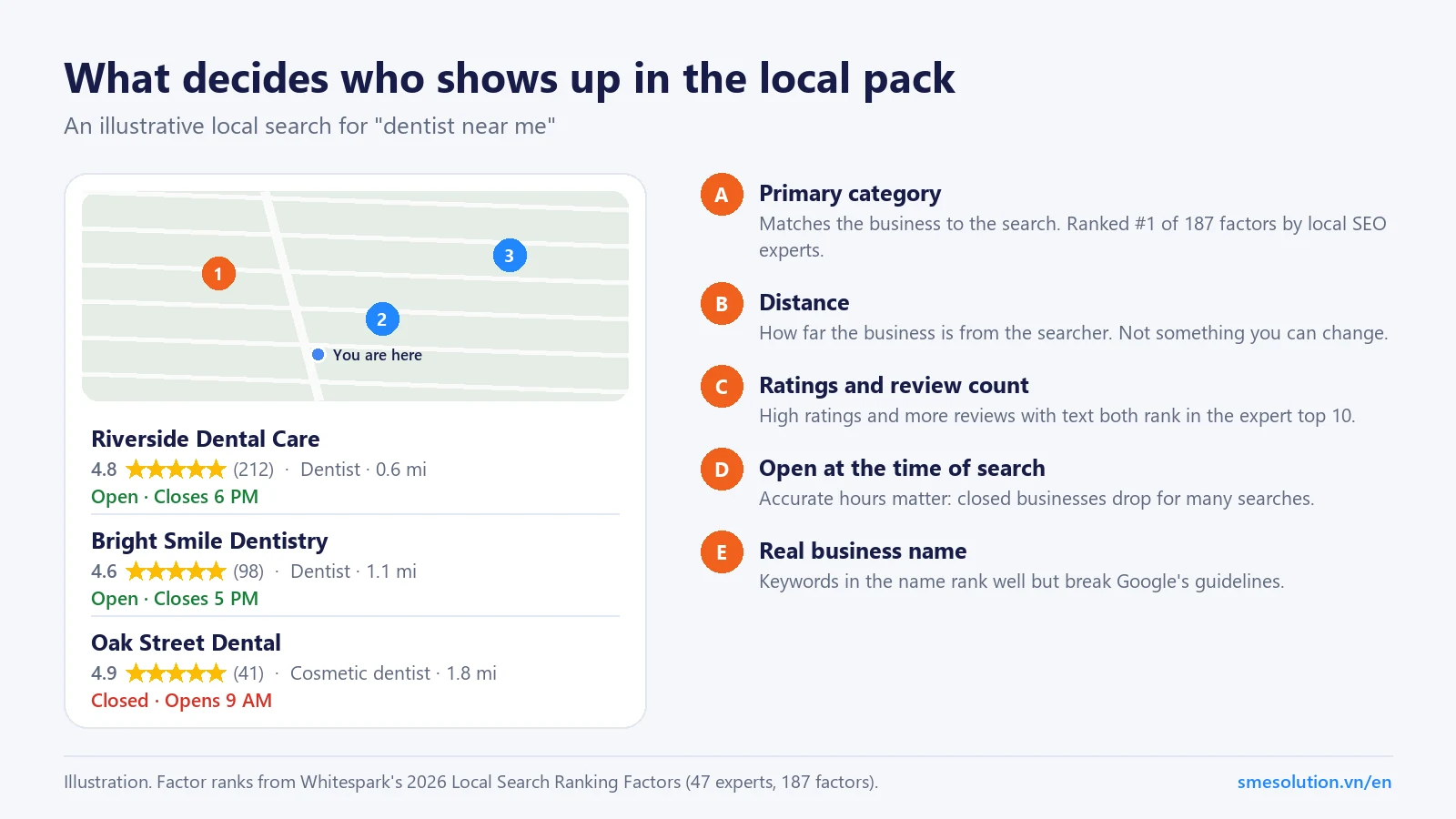
What decides who appears in the local pack. Factor ranks from Whitespark’s 2026 survey.
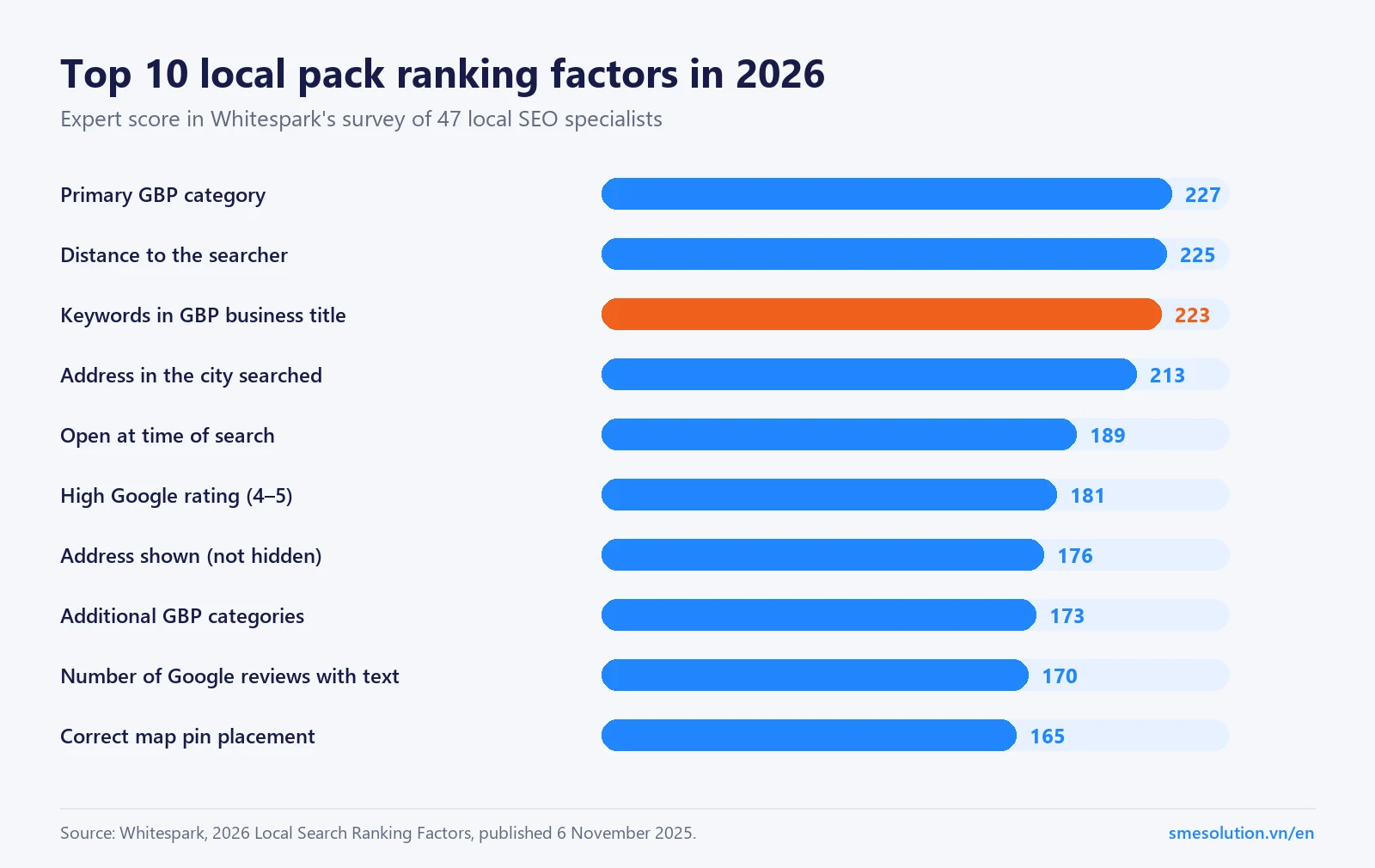
What 47 local SEO experts rank highest in 2026
Google doesn’t publish the weight of each signal, so the industry relies on Whitespark’s Local Search Ranking Factors survey. In the 2026 edition, 47 local search experts spent about two hours each scoring 187 factors. These were the ten they rated highest for the local pack and Google Maps.
Source: Whitespark, 2026 Local Search Ranking Factors.
Three things stand out. Most of the top ten live inside your Google Business Profile, which is why profile work comes first. Several are about being accurate rather than clever: correct hours, a properly placed pin, the right categories. And two are outside your control: distance from the searcher and whether your address sits inside the city being searched. Good local SEO focuses effort on what you can change.
The one top factor we won’t touch: keywords in your business name
Third on the list is “keywords in GBP business title”. Adding “Best Emergency Plumber Dallas” to a business called Smith Plumbing does tend to help it rank, which is exactly why so many cheap providers do it. It also breaks Google’s guidelines, which say your name should reflect your real-world business name without unnecessary information. Profiles that do it can be edited by Google, reported by competitors, or suspended.
We don’t do it, and we’d rather tell you why than quietly lose to someone who does. A suspended profile costs far more than the few positions a stuffed name might win. If your business name genuinely includes your service, that’s different: it’s your real name, and it’s allowed.
Our local SEO service, task by task
Here’s what we do in each area, and which part of Google’s ranking it supports.
Google Business Profile optimization
We choose your primary category for your most valuable service, add secondary categories where they genuinely apply, and list your services and products the way customers describe them. We check hours, holiday hours, attributes, your description and the map pin. This is where the top-ranked factors in the survey live, so it’s where most early gains come from. For businesses that want to start here, we offer Google Business Profile optimization as its own plan.
Local landing pages
Your website should have a page for each main service and, if you travel to customers, for the main areas you serve. Each page explains what you do there, shows real work, answers common questions and links to your profile. These pages help relevance, give Google more to understand about you, and turn visitors into calls. They’re especially important for service-area businesses, which Google asks to hide their address.
Citations and NAP cleanup
Your name, address and phone number (NAP) should match across your website, your profile and the directories that matter in your country. Mismatches don’t usually cause penalties, but they make Google less certain which details are right. We fix duplicates and inconsistencies, then add your business to the directories that are relevant to your country and industry.
Reviews: what customers expect in 2026
Reviews feed prominence and two of the top ten factors. They also decide whether people call. In BrightLocal’s 2026 survey of 1,002 US consumers:
97% read reviews for local businesses, and 41% always do.
31% will only use a business rated 4.5 stars or higher, up from 17% a year earlier.
74% look for reviews written in the last three months.
80% are more likely to use a business that replies to all its reviews, but 50% are put off by templated replies.
So we set up a simple routine for asking happy customers at the right moment, and draft personal replies for every review for you to approve. We never buy, write or “boost” reviews.
Photos, posts and Q&A
Regular photos of your premises, team and work, plus posts about offers and recent jobs, keep the profile current and give customers a reason to choose you. Answering common questions on the profile saves calls that would otherwise be lost to a competitor who did.
Tracking calls, directions and rankings
We report the actions that lead to revenue: calls, direction requests and website clicks from your profile, plus enquiries from your website. Rankings are tracked too, but as a means, not the goal. You get a written update every two weeks and a monthly report with what we did, what changed and what’s next.
Local search beyond Google Maps in 2026
Google is still the main place people look for local businesses, but its lead is narrowing. BrightLocal’s 2026 consumer survey found that Google’s share as a source of reviews fell from 83% to 71% in a year, and that people now use an average of six review sites. Apple Maps rose from 14% to 27%. The biggest jump was in AI tools: the share of consumers using ChatGPT and similar assistants for local business recommendations rose from 6% to 45%, making them the third most popular source.
What does that mean for the work? Mostly that the fundamentals pay off in more places. AI assistants and other map apps draw on the same public information: your website, your listings, your reviews and how consistently your details appear across the web. A business with accurate, consistent details everywhere and a steady stream of real reviews is in a better position on every platform, not just Google. In practice we make sure your Apple Business Connect and Bing Places listings match your Google profile, and that your website states clearly what you do, where, and for whom.
Common local SEO problems we fix
Problem
Why it hurts
The fix
A generic primary category
The profile doesn’t match your most valuable searches. The primary category is the top-ranked factor in Whitespark’s survey.
Choose the most specific category for your core service; add secondary ones only where they apply.
Wrong or missing hours
“Open at time of search” ranks fifth. Wrong hours also send customers to a closed door.
Correct regular and holiday hours, and keep them updated.
Duplicate profiles
Google allows one profile per location, and duplicates split reviews and signals.
Merge or remove duplicates, keeping the profile with the best history.
A virtual office address
Not eligible under Google’s guidelines, and a common cause of suspensions.
Use the real address, or hide it and set a service area.
Reviews coming in bursts, then nothing
74% of consumers look for reviews from the last three months.
A steady routine for asking customers after each job.
No local pages on the website
Less for Google to understand, and nowhere convincing to send visitors.
A page per main service and, for service-area businesses, per main area.
What results to expect, month by month
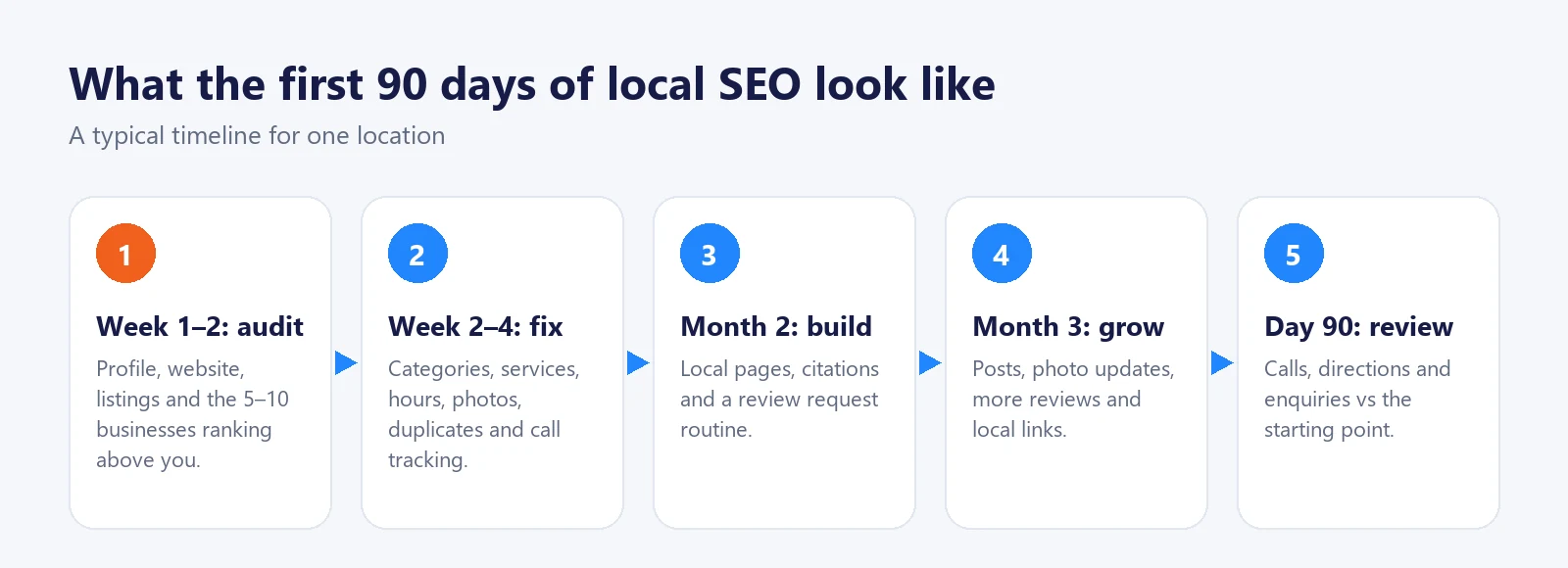
The first month is mostly diagnosis and fixes, so judge the work on what was done, not on results yet. Profiles with clear problems often move in the first one to two months once those problems are fixed. Reviews, links and local pages compound more slowly, so the fair point to judge the return is around three to six months.
Two examples from our own clients, both in Vietnam, where we’ve worked for six years. A retail store’s Google Business Profile recorded 164 calls, 1,367 direction requests and 403 website clicks between May and September 2026. A steel supplier that was barely visible on Google Maps reached the top three for most related searches in its area after about six months, with around 30 to 50 calls a month from Maps. You can see the details in our local SEO case studies.
Local SEO services pricing
Our plans are a fixed monthly price per location: $350 for Google Business Profile management, $550 for full local SEO and $850 for local SEO plus website SEO, with a 3-month minimum and no setup fee. For comparison, Ahrefs’ survey of 439 SEO providers found local SEO averaged about $1,557 a month. The full breakdown, including what drives the price and how to set a budget, is in our guide to local SEO pricing.
How to choose a local SEO company: 7 questions to ask
Who will work on my account? A named person, not just a sales contact.
What happens in the first month? Expect an audit, fixes and tracking setup.
Which numbers will you report? Calls, directions and enquiries, not only rankings.
Will my accounts stay in my name? Profile, website, analytics and domain.
Do you ever add keywords to business names, buy reviews or create extra listings? The answer should be no.
Do you guarantee rankings? Also no.
Can I see results from a business like mine? With dates and real numbers.
Is local SEO worth it?
For a business that serves a local area, usually yes, because Google Maps is where many nearby customers decide who to call. The test is simple: count the calls and enquiries that come from Google, apply your close rate and average job value, and compare with the fee. If local search brings in a few extra customers a month, most plans pay for themselves. If your area has almost no competition and you already rank well, you may only need occasional upkeep, and we’ll tell you so.
Is this for you
Is our local SEO service right for you?
✅ A good fit if you
Have a real location or a clear service area.
Care about calls and bookings more than traffic charts.
Are comfortable with written updates across time zones.
❌ Not a good fit if you
Want fake reviews, extra listings or a guaranteed #1 spot.
Only have a virtual office address, which Google doesn’t allow.
Need results within two weeks. Paid ads fit that better.
Local SEO services usually include Google Business Profile optimization, local landing pages on your website, citation building and listing cleanup, a process for getting real reviews, regular profile updates, and tracking of calls, direction requests and rankings.
Fixes to a weak profile, such as the wrong primary category or missing services, often show within 1–2 months. Reviews, links and local pages build over 3–6 months, and competitive markets take longer.
It’s worth it when the calls and enquiries it brings are worth more than the fee. For most businesses that serve a local area, Google Maps is where nearby customers decide who to call, so even a few extra jobs a month usually cover the cost.
Most agencies charge $500–$1,000 a month for an SEO retainer (SE Ranking), and Ahrefs’ survey put local SEO at about $1,557 a month on average. Our plans run from $350 to $850 per location.
No one can. Google says there’s no way to request or pay for a better local ranking, and the searcher’s distance from your business changes the results for every search. We commit to the work and to reporting real results.
You can rank on Google Maps with a profile alone, but a website with good local pages helps relevance and prominence, gives Google more to understand, and converts visitors who want more detail before calling.
Yes. We work with local businesses in the US, Canada, Australia, the UK and Singapore. Google Business Profile works the same way everywhere; we research your country’s directories and review habits before starting.